Light Skin vs Dark Skin Laser Hair Removal: How Fusion Treats Both Safely
Key Takeaways
- Laser hair removal targets melanin. Darker skin contains more melanin, so the skin can compete with the hair for the laser’s energy — which is why settings must be adjusted for skin tone.
- With the right device and parameters, laser hair removal can be safe and effective for many people with darker skin. Wavelength, pulse duration, energy level and cooling all matter.
- Light skin with dark hair is the easiest combination to treat. Light or gray hair responds poorly on any skin tone because it lacks pigment.
- Fusion Light & Dark is a diode laser with dedicated settings for lighter and darker skin tones, a large spot size and built-in skin cooling.
- Operator experience is the biggest safety factor. Ask about experience with your skin type and expect a test spot or conservative first session.
For years, people with darker skin were told that laser hair removal simply was not for them — or they had a treatment with the wrong settings and ended up with burns or dark spots. Those experiences were real, and they are a big reason many people still approach laser hair removal with hesitation. The good news is that laser technology and treatment protocols have improved significantly. Today, the question is less about whether darker skin can be treated and more about how it should be treated.
This guide explains why skin tone matters in laser hair removal, how treatment differs for lighter and darker skin, what risks to understand, and how a diode system with dedicated settings — like the Fusion Light & Dark laser we use at New You — approaches both.
Why Skin Tone Matters in Laser Hair Removal
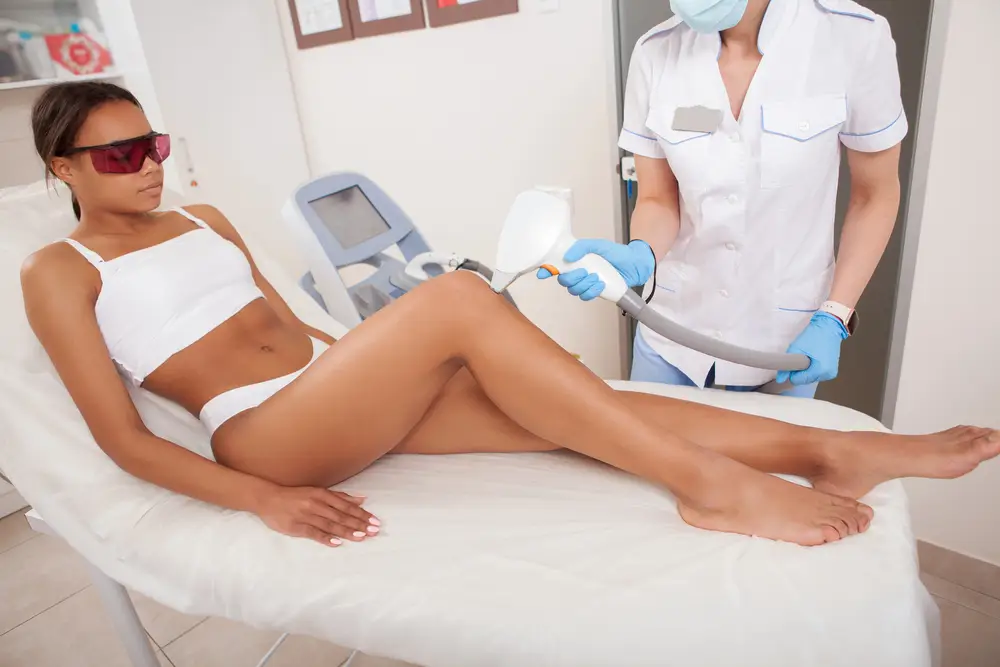
Laser hair removal works by targeting melanin, the pigment in your hair. The laser’s light is absorbed by that pigment, converted to heat, and used to damage the follicle so it produces less hair over time.
The challenge is that melanin is also in your skin. In lighter skin, there is relatively little pigment in the surface layers, so nearly all the laser energy goes where it should — into the dark hair. In darker skin, the skin itself contains more melanin, and it can absorb some of that energy too. If the settings are not adjusted, the skin heats up along with the hair, which can lead to:
- Burns or blistering from excess heat in the skin’s surface.
- Hyperpigmentation — dark patches, often called post-inflammatory hyperpigmentation, which can take weeks to months to fade.
- Hypopigmentation — lighter patches, which are less common but can be longer-lasting.
None of this means darker skin cannot be treated. It means that skin tone has to drive the treatment plan, and one-size-fits-all settings are not acceptable.
Understanding the Fitzpatrick Skin Scale
Providers commonly use the Fitzpatrick scale to classify skin into six types based on pigment and how the skin reacts to sun:
- Types I–II: very fair to fair skin that burns easily and rarely tans.
- Types III–IV: light-medium to olive skin that sometimes burns and tans gradually to well.
- Types V–VI: brown to deeply pigmented skin that rarely or never burns.
Your skin type, along with your hair color and thickness, is one of the first things a qualified provider assesses. It helps determine which laser settings are safe and how aggressive treatment can be.
How Laser Hair Removal Differs for Light vs Dark Skin
Lighter skin (Types I–III)
Light skin with dark, coarse hair is the classic ideal combination, because the contrast lets the laser concentrate its energy in the hair. Treatments can often use shorter pulse durations and higher energy, and results tend to come efficiently. The main limitation for light-skinned patients is hair color: blonde, red, gray, or white hair has little melanin to target, so it often responds poorly regardless of skin tone.
Darker skin (Types IV–VI)
For darker skin, the goal is to heat the follicle while protecting the pigment-rich surface of the skin. Providers typically achieve that through several adjustments:
- Longer pulse durations. Delivering energy more slowly lets the skin’s surface shed heat while the larger, deeper follicle continues to absorb it.
- Conservative energy levels, especially at the first session, with gradual increases as the skin’s response is observed.
- Active skin cooling before, during, and after each pulse to protect the epidermis.
- Appropriate wavelength. Longer wavelengths penetrate deeper and are absorbed less by surface melanin. Diode lasers around 800–810 nm can be used across a broad range of skin tones with proper settings, while the longer-wavelength Nd:YAG (1064 nm) is often considered for the deepest skin tones.
- Test spots. A small test area lets the provider check how your skin responds before treating a full area.
Treatment for darker skin may take a similar number of sessions, or occasionally a few more, because settings are deliberately conservative. The trade-off is a much lower risk of pigment changes.
How Fusion Light & Dark Approaches Both
At New You Skin & Body Spa, we use the Fusion Light & Dark laser, a diode system that builds on the DiolazeXL platform. Rather than treating darker skin as an afterthought, it includes dedicated settings for lighter and darker skin tones within the device itself. A few features support that approach:
- Separate light-skin and dark-skin modes that adjust how energy is delivered based on skin type.
- A large spot size and high peak power, which allow energy to reach the follicle efficiently and help larger areas be treated faster.
- A large built-in cooling surface that chills the skin during treatment, adding comfort and protection.
Technology is only part of the equation, though. Even the best device depends on the provider selecting the right settings for each patient, monitoring the skin’s response, and adjusting session by session. You can read more about the device on our Fusion Light & Dark laser hair removal page.
How to Prepare: Tips for Every Skin Tone in Sarver, PA
Good preparation reduces risk for everyone, and it matters even more for darker skin:
- Avoid sun exposure and tanning for several weeks before treatment, including self-tanners. Recently tanned skin has extra pigment and is more vulnerable.
- Shave the area a day before or the morning of your appointment. Do not wax, pluck, or thread for several weeks prior.
- Tell your provider about any history of hyperpigmentation, keloids, cold sores (for facial areas), or photosensitizing medications.
- Wear sunscreen on treated areas between sessions, and follow any aftercare instructions closely.
- Be patient with spacing. Sessions are typically several weeks apart to match the hair growth cycle and give skin time to recover.
Does Laser Hair Removal Feel Different on Darker Skin?
Sensation depends more on the area being treated, hair density, and the device’s cooling than on skin tone alone. Most people describe each pulse as a warm snap, similar to a rubber band flick. Because darker skin is often treated with longer pulse durations and conservative energy, some patients find the treatment comfortable, especially with a cooled handpiece. Mild redness and small bumps around the follicles are normal for a few hours afterward on any skin tone. What is not normal is blistering, crusting, or a sudden change in skin color — if you notice any of these, contact your provider promptly so they can assess your skin and adjust your settings for future sessions.
Questions to Ask Before You Book
- What laser do you use, and is it designed for my skin type?
- How much experience do you have treating skin like mine?
- Will you do a test spot or start with conservative settings?
- How do you handle side effects such as hyperpigmentation if they occur?
- How many sessions do you expect I will need, and how far apart?
A confident, specific answer to each of these is a good sign. Vague reassurance that “it works on everyone” is not.
What About Pigment Concerns Beyond Hair?
Some patients who come in for hair removal also have concerns like sun spots, uneven tone, or texture. Those require different technologies and careful skin-type assessment of their own. Lumecca IPL targets sun damage and redness and is generally best suited to lighter skin tones, while CoolPeel CO2 laser resurfacing addresses texture and fine lines. Your provider can tell you which, if any, is appropriate for your skin.
The Bottom Line
Laser hair removal is no longer a treatment reserved for one skin type. With a modern diode system, settings matched to your skin, and an experienced provider, many people with both lighter and darker skin can achieve long-term hair reduction safely. The key is a plan built around you, not a default setting.
If you have been hesitant because of your skin tone, the best next step is a conversation. Book a free consultation with the team at New You Skin & Body Spa in Sarver, PA, and we will assess your skin and hair, explain how Fusion would be set up for you, and answer every question before you decide.