The Norwood Scale: Causes, Stages & Treatments

- The Norwood Scale (or Hamilton-Norwood Scale) is the standard 7-stage chart specialists use to classify male pattern baldness and plan treatment.
- Male pattern baldness is driven mostly by genetics and a hormone called DHT — it’s extremely common and not a sign of poor health.
- Knowing your stage helps set realistic expectations for treatment, including roughly how many grafts a transplant might require.
- Earlier stages respond well to medication; later stages usually call for a hair transplant or non-surgical options like scalp micropigmentation.
- Wherever you fall, the team at New You Skin & Body Spa in Sarver, PA can assess your scalp and build a personalized plan.
If you’ve noticed your hairline creeping back or a thinning patch at your crown, you’re far from alone — male pattern baldness affects the majority of men at some point in their lives. The good news is that hair loss is well understood, and the first step to doing something about it is simply knowing where you stand. That’s exactly what the Norwood Scale is for.
This guide explains what the Norwood Scale is, what actually causes male pattern baldness, all seven stages in plain language, and what treatment tends to make sense at each one. Whether you’re just starting to wonder about your hairline or you’ve been watching it change for years, you’ll come away knowing your options.
What Is the Norwood Scale?
The Norwood Scale, also called the Hamilton-Norwood Scale, is a visual classification system used to measure the stages of male pattern baldness — known medically as androgenetic alopecia. It uses a series of illustrations that map the typical progression of hair loss, from a full head of hair through to advanced baldness.
It has a bit of history behind it. Dr. James Hamilton first developed the system in the 1950s, and Dr. O’Tar Norwood revised and expanded it in 1975 into the seven-stage version specialists rely on today. By matching your hair pattern to the illustrations, a provider can pinpoint your stage, track changes over time, and recommend the most effective treatment for where you are.
What Causes Male Pattern Baldness?
Before the stages, it helps to understand the “why.” Male pattern baldness is largely genetic, and the main biological driver is a hormone called dihydrotestosterone, or DHT — a derivative of testosterone. In men who are genetically sensitive to it, DHT gradually shrinks (or “miniaturizes”) hair follicles over time. The affected follicles produce thinner, shorter, weaker hairs with each growth cycle until they eventually stop producing visible hair altogether.
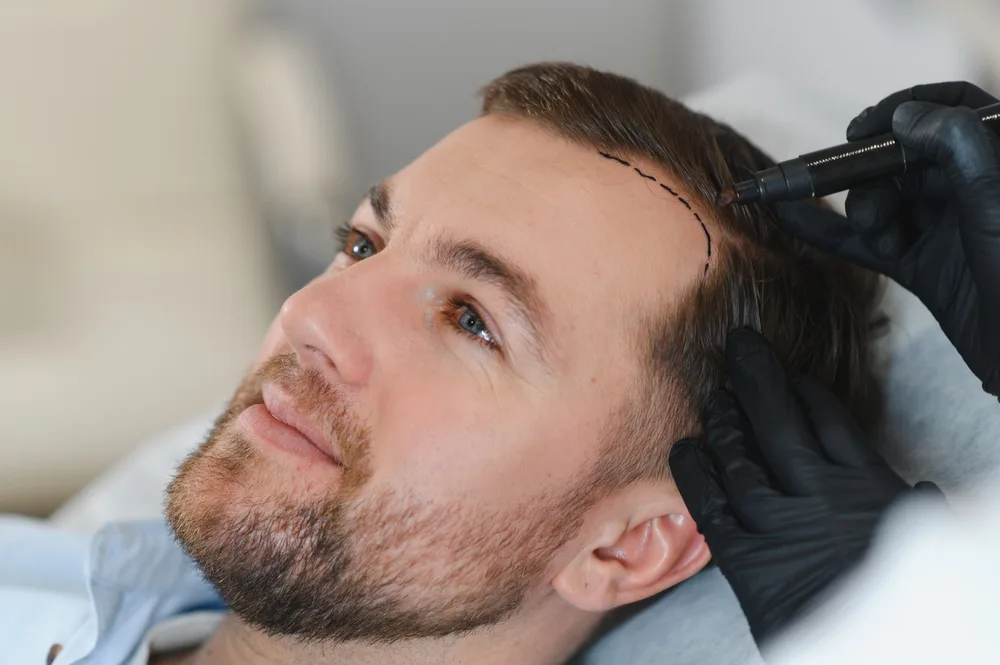
Crucially, this sensitivity follows a predictable pattern: the follicles at the front and top of the scalp are vulnerable, while those at the back and sides are usually resistant. That’s why men rarely go bald around the lower back of the head — and it’s also the reason hair transplants work, since those resistant “donor” follicles keep growing even after they’re moved.
Worth knowing: Because male pattern baldness is mostly inherited and hormonal, it isn’t caused by hats, shampoo, or “clogged” follicles. A receding hairline is normal biology — and there are real, effective ways to address it.
The 7 Stages of Male Pattern Hair Loss
Here’s a breakdown of each Norwood stage and what it typically looks like.
Stage 1: Minimal or No Hair Loss
Hair looks full with no noticeable recession at the hairline or crown. This is the baseline “control” stage. No treatment is needed — though if baldness runs in your family, it’s never too early to learn your options.
Stage 2: Early Recession
You may notice slight thinning or a small recession at the temples, forming the beginnings of a more mature hairline. This is still within the range of a normal adult hairline. Treatment is optional, but some men start preventive medication here.
Stage 3: Deepening Recession
This is the first stage officially considered “baldness.” The hairline recedes more deeply at the temples, creating a noticeable M, U, or V shape. This is a common point to act, whether with medication to slow loss or by considering an early transplant.
Stage 3 Vertex: Thinning at the Crown
A variation of Stage 3 where the hairline may be relatively stable but a distinct bald spot develops at the crown (the top-back of the head). Treatment is similar to Stage 3, often with extra focus on the crown.
Stage 4: Further Recession and Crown Thinning
Hairline recession becomes more pronounced and the crown bald spot grows larger. A band of hair still separates the front from the crown. Many men explore hair transplants at this stage, sometimes combined with medication.
Stage 5: The Bridge Narrows
The band of hair separating the front and crown becomes thinner and may begin to break down. Both bald areas are noticeably larger. Medication alone is often less effective here, so a hair transplant is frequently considered.
Stage 6: Front and Crown Connect
The bridge of hair between the front and crown is largely gone, so the two bald areas merge into one. Hair remains mainly on the sides and back. A hair transplant is the most common surgical option, provided there’s enough donor hair available.
Stage 7: Advanced Baldness
The most advanced stage, where only a narrow “horseshoe” band of hair remains along the sides and back of the scalp. Options may be more limited but can still include a transplant using donor hair from the sides, or non-surgical approaches like scalp micropigmentation or hair systems.
The Norwood Scale at a Glance
| Stage | Pattern | Common Treatments |
|---|---|---|
| 1 | No visible loss | None needed |
| 2 | Slight recession at temples | Preventive meds (Minoxidil, Finasteride) |
| 3 | Deeper recession, “M”/”V” shape | Meds, early transplants |
| 3 Vertex | Bald spot at crown | Meds, crown treatments, early transplants |
| 4 | More recession + bigger crown spot | Combined treatments, hair transplant |
| 5 | Front/crown almost connected | Hair transplant recommended |
| 6 | Bald area merges; sides still have hair | Larger transplant sessions |
| 7 | Only hair at sides/back | Transplant, scalp micropigmentation, hair systems |
How Specialists Use the Norwood Scale
When you visit a clinic for hair loss, the Norwood Scale is one of the first tools your provider reaches for. It does a few important jobs at once:
- Assessment. Your scalp is compared to the standard illustrations to pinpoint your current stage.
- Planning. Your stage helps estimate the treatment area and roughly how many grafts a transplant might need.
- Tracking progress. If you start medication, the scale makes it easy to measure how your hair changes over time.
- Setting realistic goals. It helps match your expectations for density and hairline design to the donor hair you actually have.
It’s also a useful reference point for distinguishing normal change from true loss — our guide on a mature hairline vs. a receding hairline digs into that common question.
At Which Stage Should You Seek Treatment?
There’s no wrong time to ask for advice, but the general principle is that earlier action gives you more options. The sooner you address thinning, the better your chances of slowing it down — or even regrowing hair — with medication or other therapies.
- Stages 1–2: If baldness runs in your family, a conversation now can help you get ahead of it before loss becomes noticeable.
- Stages 3–4: Early to moderate loss tends to respond well to medication, transplants, or a combination of both.
- Stages 5–7: More advanced stages can limit some options, but transplants, scalp micropigmentation, and modern hair systems can still deliver remarkable results.
If you do decide on a procedure, knowing what comes next helps — our hair transplant timeline and preparation guide walk you through the whole journey. For those earlier on the scale, a supplement like Nutrafol may help support the hair you have.
Find Out Where You Stand
Identifying your Norwood stage is the first step toward feeling confident about your hair again — and you don’t have to figure it out alone. Dr. Jerry and the team at New You Skin & Body Spa in Sarver, PA can assess your scalp, explain your stage clearly, and build a personalized plan, whether that means prevention, NeoGraft hair restoration, or simply peace of mind. Call 724.294.8450 to book a consultation.
Disclaimer: The information provided here is for general knowledge only and should not be considered medical advice. For any questions or concerns about your health or medications, please consult your physician or healthcare provider, who is best equipped to provide guidance specific to your needs.